CHAPTER 16
PRACTICAL
This was it. The final and most important part of the test was to begin a little later than the others, at the fourth hour. There were still six of them as all had learned of their success in the previous afternoon’s test, Carthinal and Ebrassaria again gaining distinctions. (The elf had looked rather piqued to find that a mere half-elf seemed to be matching her efforts in the written tests.)
This time, instead of going upstairs to the room where they had done their written tests, they were escorted down many flights of stairs to a room well below ground level. They were left in a circular room devoid of furniture, but which boasted seven doors in the walls, including the one through which they had entered. Six mages entered from the other doors and introduced themselves to the candidates. There was to be one mage to watch each candidate. Carthinal’s examiner was an elven mage who introduced herself as Yssalithissandra. (Yssa for short she told him in a whisper, giving him a wink.) They were each to enter a different door, and had six hours to find the door to return to this room. There would be a number of different problems and dangers for them to overcome. On their return, they would be assessed on the efficacy of their use of magic and how well they conserved their strength as well as the intelligent way they solved any problems they might meet on the way. They were allowed to take one scroll and one weapon with them, but no magical items. The last word to them was a warning that there was a very real danger of death in the test before them, and that if any of them wished to pull out, now was the time.
Carthinal looked round. No one moved, although Olipeca looked rather pale, and Grimmaldo looked decidedly green. No. No one was going to pull out. They all selected their weapon and scroll. Carthinal chose to take his dagger, which he always had strapped to his wrist, and a True Seeing scroll, having decided that it was quite possible that much of what was behind the door would be illusion. Even with that knowledge he knew that illusions could be deadly too.
They all moved forward as one. As they reached the doors, Grimmaldo whispered “Good Luck” to Carthinal. He did not have his usual cheery grin, Carthinal noted, and he was looking decidedly nervous. Carthinal wondered if he looked as scared and if they would all return through those doors.
The door closed and he was alone in the pitch darkness. He could see nothing at all with normal vision, so he looked around for any heat sources that may denote a living being. Towards the end of the corridor, he could see a vaguely humanoid-shaped red glow.
‘Is this enemy number one?’ he wondered. ‘I’d better walk quietly closer and see.’
This he did, in the pitch dark, until he could make out a distinctly hobgoblin smell.
‘OK,’ he thought to himself, ‘I can deal with this without my spells,’ and with that, he released his dagger from the harness holding it on his forearm and in the same movement threw it unerringly towards the creature’s throat. He was rewarded with a gurgle and saw the reddish shape slump to the floor, the redness fading as the body began to cool in death. Carthinal quickly retrieved his dagger while he could still see it.
Now there was only blackness. No sign of any further enemies, but a few paces away from where the body of the hobgoblin lay, the corridor finished in a blank wall.
‘What now?’ he muttered aloud. ‘There must be a secret door somewhere. I’ve got six hours to complete this test, so there is no rush. At least not yet.’ He leaned against the wall to think, and as he moved his feet, he heard a sound beneath them and realised that there were rushes on the ground. ‘Torches! Yes!’
Carthinal knelt down and gathered a bunch of the rushes. They were dry, so he set about making a torch. He knew that if he just set light to them, as they were, they would burn far too quickly, so he plaited the ends where he would grip them, and left the tops free. He made a number of these rush torches, taking the time to do so since he had no idea if he would find any more further into the labyrinth, or so he surmised it to be. After he had what he considered to be a sufficient number, he used the cantrip that he had used to light the fires on his journey with Asphodel and Bas to light the first torch. It took a few seconds to light, and he thought that it was not going to work but then suddenly there was a splutter and the makeshift rush torch was burning.
The end of the corridor proved not to have any signs of secret doors. He searched twice to be sure, then slowly made his way back up the corridor towards the door through which he had entered. There was no sign of a door on the right hand side, nor, to his surprise, was there any sign of the door through which he had entered.
‘Well that ensures we don’t go back anyway,’ he said to himself, as he began to search the other wall of the corridor. ‘Ah! I knew there must be something somewhere!’
He could see the very finest line in the stonework. It was hardly visible, but his elven heritage had given him excellent vision. He did wonder for a moment how non-elves would set about finding this door, but it was not his problem, so he put it aside. Mabryl had told him to focus on the problem to hand and not to worry about things he could do nothing about.
‘That way lies death,’ Mabryl’s voice whispered in his mind. He also remembered similar instructions from his life in the gangs, before Mabryl had saved him.
It took but a couple of seconds for him to discover the mechanism that opened the door and then a portion of the wall swung inwards with a grinding sound.
‘Kassilla’s tits!’ he swore. ‘If anything’s in there, it would have heard that a mile away.’
Ensuring there were no rushes to set on fire on the floor of this new corridor, Carthinal stubbed his torch out. He stood in the dark, searching the corridor for signs of life. No red glowing figures were visible, nor did he hear any sounds. Wait! Was that a shuffling? No… Yes! There was something out there. But he could see no heat sources. Then he realised with a sinking feeling. One of his biggest dreads! Undead!
Well, they knew he was here, and he must be able to see them if he was to fight them, so he quickly re-lit his torch. Sure enough, shuffling slowly along the corridor was a zombie. Carthinal’s mind began to work quickly. He needed something more than his dagger here as it was unlikely that a single throw would stop the zombie. Zombies fought with their bare hands, hitting and clawing at their victims, but could do a tremendous amount of damage, especially to an unarmoured mage. He therefore could not get into close combat with it. A spell then, that was the answer. Trying any mind influencing spell was no use as undead were generally immune to such spells, not having a mind to affect, so it was no use trying to put it to sleep. He decided to use small bolts of energy. He quickly took the mana into himself and wove the pattern to absorb energy from the surroundings and transfer it into darts of pure energy. Two silvery darts shot out from his fingertips to bury themselves unerringly in the zombie’s chest. It staggered and fell to the ground, twitched a few times and then was still.
‘I hope there are no more of them! I hate undead, they give me the creeps.’ Carthinal was not sure why he was talking aloud. ‘Maybe for reassurance,’ he reasoned, ‘After all, I could actually die in here.’
The thought was not a pleasant one, and he quickly quashed it, but like everything that one tries not to think about, the idea kept returning. To try to stop it, he began to talk to himself again.
‘I think that I’ve been in here now about an hour and a half. Time to find the door, time to make the rush lights, and two enemies to dispatch. Still plenty time, but then, I don’t know, do I? I’ve no idea how far I have to go, or what I must face. I’d better move on.’
The corridor seemed to curve to the left, meaning that Carthinal could not see very far in front of him. It was worse than a sudden corner, as there he could have stopped and looked carefully round it, so he walked slowly and quietly along, pausing every few yards to listen. It meant that his progress was very slow, but he was as sure as he could be that he was not running into danger unprepared. The long curving corridor eventually came to an end with no further traps or enemies to be overcome, and then forked into two ahead of him.
‘Now which way?’ he wondered.
He decided to toss a coin as no other ideas came to him. Heads, left, tails right. It came down heads, so he took the left fork. Again there was no sign of an enemy, but he moved with care just in case. The corridor ended in a blank wall. He searched again for any secret doors, but this time he drew a blank.
‘Seems like I should have gone right then. So much for the God of Chance!’ he murmured as he retraced his steps. This time he took the right hand fork. He estimated that his caution on the curving corridor and the wrong turn had taken up another hour, leaving four more hours to find the way out.
He noticed that the corridor ahead had a number of alcoves in it.
‘What a good place for an ambush,’ he thought.
Almost as a reflex, he stubbed out the light. That would have let anyone know exactly where he was. He paused. Yes, sure enough, there were heat sources in some of those alcoves. He moved backwards, confidant that whatever or whoever was in the alcoves would have seen his torch and be expecting him. He leaned against the wall while he thought. It may be that there were enemies in the further alcoves too. In which case, they would wait until he had passed the first ones and then surround him. That was what he would do in their place. He considered using a protection spell to give himself some armour, but quickly rejected it, as it would use up his energy and probably to no avail if he were fighting in close quarters with enemies in front and behind. No, he would need to draw them out somehow while he was still on this side of them all, so that he could put them to sleep and put at least some of them out of commission while he dealt with the rest.
He quickly made a plan, and then ran it through his mind again to look for any flaws. There were flaws, of course, not least that he did not know what kind of creature he was dealing with. He assumed that the mages would not put in anything that a final grade apprentice should not be able to deal with, so he began to execute his plan.
First, he felt around for any pebbles or stones, and picked up a few, then he crept forward silently, as only elves and their kin can do. When he was within spell range, he stepped out and began to shuffle on the spot. Sure enough, he saw the creatures in the first two alcoves begin to prepare. He noted with relief that they did not seem to be too large, maybe kobolds or goblins. Next, he took out a small pebble and tossed it to just in front of the first alcoves, he then tossed a second between the alcoves. Using a simple cantrip that he had learned in his early days with Mabryl, he said, “Shit!” and caused the sound to appear to come from the position of the second pebble.
Immediately, four goblins emerged from four alcoves, waving short swords at the empty space between them. Goblins are not noted for their intelligence, and after whacking each other a couple of times, they stood around in confusion. This gave Carthinal the chance to get a sleep spell off and within a few seconds, three of the four were snoring on the floor. Carthinal quickly took out the fourth with his dagger, thrown with deadly accuracy, and then re-lit the torch before going over to retrieve his weapon and dispatch the remaining three.
He was beginning to feel tired and thirsty so he decided that there was time for him to rest for a few minutes. He took a drink out of the pack that all the apprentices had been given and sank down onto the floor and drank deeply, but he did not empty the flask. Having decided to remain there for another half-hour before continuing on, he re-lit a torch while he rested and put it in a sconce that he noticed on the wall. It gave a welcome light. He considered his progress so far and felt that he had done all right. He had got past three enemies and only used two simple spells so far. That meant he had enough energy left for several more, depending on their difficulty and the amount of mana they drew. He did not see that there could possibly be more than one more enemy, or it would have been well nigh impossible for many that would rely completely on spells. However, there would almost certainly be tests of ingenuity and intelligence.
When he estimated that the half hour rest he had allowed himself was up, he stood, stretched to get rid of the stiffness from sitting on the floor, and once more shouldered his pack and set off down the corridor, having picked the torch up out of the sconce. He had decided that he would like some light for a while, reasoning that there would be no enemies in this part of the tunnel as he had just passed some, so he carried the torch still lit. A corridor branched off to the left. Should he take it or go straight on? He pondered for a minute, and then decided to continue along the corridor that he was travelling down. If it came to a dead end, he could always backtrack to here. The corridor continued to have alcoves along it for some distance, but then they suddenly stopped. The corridor widened and became a large circular room with four doorways leading from it. The four doors were closed, but in the centre of the room was a circular device made of metal. On the top was a second circle of metal, slightly smaller, with an arrow engraved on one side.
Carthinal looked carefully at the device and it became apparent that the piece of metal on the top rotated over the lower one. There were four lines engraved on the lower circle across the diameter and at right angles to each other. Carthinal did not touch it yet. He decided that he needed to know more before doing anything. He looked around the room, and saw that there was writing all around, just above the height of the doors. Just at that moment, his rush torch went out.
After he had lit another, noticing that he was getting down to the last few, he approached the wall to the left of the door through which he had entered the room and held up the torch. There was a two-line rhyme, which read,
‘The spring wind blows cross mountains wide
‘Through land of horse where barbarians ride.’
Continuing round the room, he pieced together the following,
‘From icy mountains encased in snow
‘In winter do the cold winds blow.
‘The summer winds are soft and warm
‘They blow from desert and waving palm.
‘The autumn winds are rough and wild
‘They bring doom for man and child.
‘So turn me round and I will show
‘The proper way that you must go
‘But get it wrong and sorry be
‘For you must fight or you must flee.’
‘It’s some sort of puzzle to locate the correct door.’ surmised Carthinal.
He paused to consider the words again. He wanted to be absolutely sure that he got it right as he did not want to face the consequences of a wrong choice.
‘“Turn me round.” That’s probably the device in the centre. It must be like a combination lock,’ he muttered. ‘I don’t suppose that there will be any help in listening for mechanisms working. It implies that a door will open anyway, and if it is wrong, dire consequences will result. OK. Then the other rhymes must give the directions. The second one must be the south wind as the Great Desert is in the south. The Barbarians with their horses are over the Western Mountains, so that must be the west wind. The one from the icy mountains must be the north wind, which leaves, by a process of elimination, the east wind for the final one. Ah! Got it. The clue is in the word “doom”. The Mountains of Doom are to the east. That means it refers to the compass directions in the order: west, north, south and east. That must be the direction that I turn the wheel.’
The problem now was locating north. There had been so many twists and turns that Carthinal had lost all sense of direction. ‘Bas, I could do with you now!’ he said, thinking of the ability of dwarves to locate direction underground. ‘Or I could do with a lodestone.’
He considered for a little longer, then decided that the mages would not have given an impossible task, so maybe there was a lodestone, or some other hint, hidden somewhere and he had missed it. First of all, he searched the room carefully. Nothing became apparent, so he backtracked to the corridor that he had missed. He entered it holding his light high and walking with care, on the look out for enemies. There did not seem to be any danger down this tunnel. Suddenly, his light glinted off something in the wall of the tunnel. It was the door to a cupboard cut out of the rock. It was the metal ring to the left side of the door that glinted. He did not know whether there were any traps on the door, so he took his dagger and, standing to the side and as far away as he could, he raised the latch. The door swung open. He waited for a few seconds until he was fairly sure that nothing was going to go off belatedly, and then held his light so that he could see into the space. At first he saw nothing, but when he put his hand into the cupboard and felt around, he came across a small object. On withdrawing it, he saw that it was a small case with a glass lid, and suspended inside the case was a small piece of lodestone, one end marked with red paint.
‘Just what I was looking for!’ he remarked, feeling rather smug.
He retraced his footsteps until he came back to the large round room, and now he could establish which way north was. He put the lodestone down, and turned the upper wheel until the notch was pointing to the west. After that he rotated it to the north, then south, then east.
There was a rumbling sound. Carthinal held his breath, and the second door to the right slowly swung open. He waited for a few seconds, but nothing came out so he put out the torch so he could use infravision better and carefully approached the tunnel. No heat sources to be seen, so he cautiously entered. Feeling his way along, Carthinal crept along a tunnel that wound backwards and forwards, sometimes seeming to go back on itself a number of times. By now he had lost all sense of time, but decided that since no one had come to collect him, he must still be within the six hours, although it felt that he had been creeping along dark tunnels for days. He stopped for another drink and a look around. Still no heat sources. He lit another torch, noting with dismay that it was his last, and praying to Majora that he was near enough to the end for it to last.
After a short while, there seemed to be a wall in front of him. He stopped, thinking that there had been no side passages for him to miss. Then he noticed that there was a cool breeze around his feet. Looking down, he saw a dark shadow towards the bottom of the wall to his left. He knelt down, and sure enough there was a low passage, only high enough to crawl along. Carthinal did not like this idea, as he felt vulnerable being unable to run, and with insufficient space to cast spells or throw his dagger. Memories came unbidden as to how mages sometimes died in the practical test. The more he tried to push those thoughts away, the more they stalked him, like ghosts, quietly and almost imperceptibly. He broke out into a sweat, and felt himself begin to shiver.
‘This is no good,’ he told himself. ‘If you want to pass this damned test, you’ve got to go in there! Remember you promised Mabryl to do you damnedest to get through.’
With that, he hitched his robe out of the way so that he could crawl, put out the light as there would be no possibility of using it safely, and it would have been so humiliating to set himself on fire and have to be rescued. So he entered the tunnel.
‘Thank the gods for infravision. This would be a dreadful ordeal if one could not see anything at all.’
Occasional small heat sources could be seen, but they were just spiders and beetles. Carthinal’s skin crawled as he thought of them getting in his clothing and onto his skin. Second only to undead, Carthinal hated spiders. Eventually, after what seemed to him like hours of crawling, but was in reality only about fifteen minutes, the crawl way ended in another large room.
At the entrance to the crawl way, Carthinal paused and looked. ‘Oh shit!’
Ahead of him was a large shape glowing red. It turned its eight red glowing eyes towards where Carthinal was crouching by the tunnel. By the shape of it, it was a gigantic spider.
‘Oh shit!’ he re-iterated as the creature began to run towards him across the room.
Then he thought of the true seeing spell that he had on a scroll. Reasoning that the mages would not deliberately try to kill their apprentices, he quickly pulled it out and began to read it. The spell took effect just as the spider was about to strike, and to his relief it disappeared. It had been an illusion after all. However, behind where the spider had been there was a door. Carthinal ran across to it, looking around for any more nasty surprises, and pulled the door open. Light flooded into the cavern, blinding Carthinal for a moment, and he staggered over the threshold. Hands guided him to a chair, and voices were congratulating him for being the first one back. Slowly it dawned on him that he was out of the tunnels, and had succeeded in completing the practical test. His sense of relief was immense, and he offered up a prayer of thanks to Majora for his success. It was several minutes before he realised what it meant. He had passed his test and was now no longer an apprentice.
‘I did it, Mabryl. You said I would, but I didn’t believe you,’ he murmured.
‘What did you say?’ said a voice at his side.
‘Oh, nothing. Was I talking aloud?’
He turned to see who had spoken. It was the mage who had overseen his test, Yssalithissandra.
‘Well done. You got back with half an hour to spare. We’re expecting some of the others any time now. How are you feeling?’ she sounded genuinely concerned, so Carthinal stood up and told her he was feeling fine.
He stretched and looked towards the other doors. One of them was opening, and through it came Olipeca. She looked very tired, but not completely spent. He guessed that she had not needed to use all her spells either. Her examiner escorted her to a chair, and spoke reassuring words to her. Suddenly, she seemed to realise that she was out of the test tunnels and within the given time. Her face lit up with a smile. Her hair had come loose from its customary tight and severe style. It hung loose around her face, and the ecstatic smile on her face, as she realised she had made it through in time, made her look almost pretty.
Then one of the other doors opened and through it staggered Grimmaldo. He just about managed to get over the threshold when he collapsed into the waiting arms of his examiner, and was all but carried to a chair. He had just made it with only a few minutes to spare, but he had made it. Carthinal looked around. There were three of them back, and there were five arch-mages. Carthinal was just going to ask where the sixth arch-mage was when another door opened and he came in carrying something. He put it down on the floor, and the others could see that it was Laurre. He was lying very still. The mage said something to the others which the now ex-apprentices could not hear. Then he came over to where they were waiting.
‘I am very sorry to tell you that your friend, Laurre did not make it through the labyrinth. He died in the ambush section. A great pity. We always regret the loss of a student, but the tests are essential as I am sure you appreciate.’
‘What about Ebrassaria and Hammevaro?’ asked Grimmaldo. Just as he was speaking, and as the final few seconds of the time ticked away, one of the last two doors opened and Hammevaro literally fell into the room, and was immediately violently sick on the floor. One of the mages called for an apprentice to clear it up as he lifted Hammevaro to one of the chairs, where he immediately passed out.
‘Well, he’s just made it,’ whispered Grimmaldo, ‘But what about Ebrassaria?’
In answer to his question, one of the wizards entered the final door and a few minutes later emerged with Ebrassaria clinging onto his arm. She looked the worst of them all, barely able to stand, and paler even than Grimmaldo had looked before entering. The arch-mage accompanying her led her to a chair and sat her down. He gave her sips of water and talked to her quietly. She did not seem to realise what was going on or where she was at first, then suddenly it seemed to dawn on her that she was out of the labyrinth and that since she had required an escort out that she had not passed the practical. She burst into tears.
Yssalithissandra spoke quietly to the others. ‘Of course, this means that she has failed to pass this test as she did not get out of the labyrinth in time,’ she sighed. ‘A great pity as she did so well in the theory. Still, a mage needs to be a practitioner as well as a theorist. She can always retake another time.’
As the group of newly promoted mages was leaving the room Yssalithissandra approached Carthinal. Grimmaldo, and Hammevaro left to collapse somewhere to sleep, and Olipeca to find her master to give her the good news.
‘I have something that Mabryl was bringing for you,' Carthinal told her. ' An old spell book that he thought would help you in your research of the old knowledge’
'Really?' replied the woman. 'How odd that I should turn out to be your examiner then. Come to my rooms later then and you can give it to me and we can talk about Mabryl. I knew him well when he was in the tower and would like to catch up on his life after he left here.'
'Thank you,' Carthinal answered, 'I would like that.' He realised that he was telling the truth. He was now ready to deal with Mabryl's death and actually wanted to talk about him.
Friday, 24 October 2014


Tuesday, 21 October 2014
Changes.
I've been a bit remiss in writing recently. I must redress that. I was thinking recently about how things have changed during my life. I can't really remember the 40s, but the 50s is quite clear to me. I am going to sound like a really old woman harking back to my youth I suppose, but here goes anyway.
In my youth we were taught to put other people first. We had to put their wishes before our own. We also had to be considerate of others. An example of modern life was yesterday. We had trouble getting into a drive due to a car parked opposite the gate in a narrow road. There was plenty of space elsewhere. For someone, that was convenient for them and to hell with anybody else. People park on bends, at junctions, double park, or, as yesterday, just staggered so it's difficult to drive a large car through.
We were also taught that manners is what makes living in society possible. People now don't say please and thank you as a matter of course, they push past with no excuse me, walk in front of you when you are looking at something and stand talking and blocking the pavement.
When I was growing up we were taught that if adults were coming towards you and your friends you should go into single file and not make the adults do so or step off the path. I now am still having to do this for youngsters and it annoys me.
In the 50s you NEVER heard swearing in the street. A parent would not dream of swearing in front of their children and certainly not at them. The F-word was not used. Certainly not commonly as it is now. Every day you hear it in the street. Blasphemy too. That was not heard. Even if someone were a non-believer they didn't say 'oh my God' or 'Jesus'. There was respect for those who were.
Coughing and sneezing. Nowadays people cough without covering their mouth and will cough and sneeze in your face, spreading germs. Also spitting.
We used to offer sweets round and were taught that if you didn't have enough to offer round, then you didn't eat them yourself.
If you couldn't say something nice, don't say anything.
I think it started to change in the 60s when counsellors started to tell people to have some of what is now called 'me time'. This has gone too far and people are putting themselves before everyone else. Can it change? I don't know, but I worry for society if we don't.
In my youth we were taught to put other people first. We had to put their wishes before our own. We also had to be considerate of others. An example of modern life was yesterday. We had trouble getting into a drive due to a car parked opposite the gate in a narrow road. There was plenty of space elsewhere. For someone, that was convenient for them and to hell with anybody else. People park on bends, at junctions, double park, or, as yesterday, just staggered so it's difficult to drive a large car through.
We were also taught that manners is what makes living in society possible. People now don't say please and thank you as a matter of course, they push past with no excuse me, walk in front of you when you are looking at something and stand talking and blocking the pavement.
When I was growing up we were taught that if adults were coming towards you and your friends you should go into single file and not make the adults do so or step off the path. I now am still having to do this for youngsters and it annoys me.
In the 50s you NEVER heard swearing in the street. A parent would not dream of swearing in front of their children and certainly not at them. The F-word was not used. Certainly not commonly as it is now. Every day you hear it in the street. Blasphemy too. That was not heard. Even if someone were a non-believer they didn't say 'oh my God' or 'Jesus'. There was respect for those who were.
Coughing and sneezing. Nowadays people cough without covering their mouth and will cough and sneeze in your face, spreading germs. Also spitting.
We used to offer sweets round and were taught that if you didn't have enough to offer round, then you didn't eat them yourself.
If you couldn't say something nice, don't say anything.
I think it started to change in the 60s when counsellors started to tell people to have some of what is now called 'me time'. This has gone too far and people are putting themselves before everyone else. Can it change? I don't know, but I worry for society if we don't.
Friday, 10 October 2014
busy and traumatic times.
I haven't posted for awhile now. I have had quite a time in the last couple of weeks, so I apologize.
We went to Brighton to visit my son a couple of Saturdays ago, and as I was driving along the front I passed a cyclist. There are lots of sets of traffic lights along the front and so the traffic was going slowly. The lights in front of me, which had been green until that point, changed and so I stopped. Suddenly there was a loud bang, and both I and my husband thought the car behind had run into us. However, on looking through the mirror, I saw that the car behind was not near and the cyclist was cycling across the road. She had run into our car, put a dent in the boot and cycled off. The man in the car behind said it was her fault as she was looking at him to see what he was doing and not at me. We were a car's length from the lights, ao what the heck was she doing trying to cross a busy road between the traffic when she could have safely crossed at the lights.
Then there was the breakdown of the car that I wrote about last time.
The following Monday we went to pick up the grandchildren from school and take Bethany to hr swimming lesson. I had to get her out of the pool early because we had a telephone call from our daughter to say that she'd had a car accident. she was driving our second car, an Alfa GTv, when someone came round a corner too fast and ran into a queue of traffic at the traffic lights, pushed at least one of them into the one in front, bounced off and into our car that was coming the other way. His insurance company has admitted liability, but my daughter was very badly shaken up and the car is a write-off.
This had meant loads of work sorting out insurance claims and looking for another car.
So my apologies for not posting for a while. I will be posting the next chapter of The Wolf Pack, possibly tomorrow.
Also, Part 2 of The Wolves of Vimar, The Never-Dying Man, is now out on Kindle and will shortly be out in print format with CreateSpace and Amazon.
We went to Brighton to visit my son a couple of Saturdays ago, and as I was driving along the front I passed a cyclist. There are lots of sets of traffic lights along the front and so the traffic was going slowly. The lights in front of me, which had been green until that point, changed and so I stopped. Suddenly there was a loud bang, and both I and my husband thought the car behind had run into us. However, on looking through the mirror, I saw that the car behind was not near and the cyclist was cycling across the road. She had run into our car, put a dent in the boot and cycled off. The man in the car behind said it was her fault as she was looking at him to see what he was doing and not at me. We were a car's length from the lights, ao what the heck was she doing trying to cross a busy road between the traffic when she could have safely crossed at the lights.
Then there was the breakdown of the car that I wrote about last time.
The following Monday we went to pick up the grandchildren from school and take Bethany to hr swimming lesson. I had to get her out of the pool early because we had a telephone call from our daughter to say that she'd had a car accident. she was driving our second car, an Alfa GTv, when someone came round a corner too fast and ran into a queue of traffic at the traffic lights, pushed at least one of them into the one in front, bounced off and into our car that was coming the other way. His insurance company has admitted liability, but my daughter was very badly shaken up and the car is a write-off.
This had meant loads of work sorting out insurance claims and looking for another car.
So my apologies for not posting for a while. I will be posting the next chapter of The Wolf Pack, possibly tomorrow.
Also, Part 2 of The Wolves of Vimar, The Never-Dying Man, is now out on Kindle and will shortly be out in print format with CreateSpace and Amazon.
Sunday, 28 September 2014
The weekend
We were going to go to Old Trafford on Saturday. On Friday evening we went to meet my sister-in-law in Cambridge and the car broke down. The key wouldn't switch on the ignition. We had to get my brother-in- law to come out to take us to his house where we were staying overnight.
Next day we rang Mercedes roadside help and their man said the steering lock has failed. This means that when the key was put in it didn't release the lock as it normally would because it wasn't in fact locked. The car didn't know this and so said 'I'm not going anywhere with locked steering.'
We had to wait for the rescue vehicle then we went to th Botanical Gardens. We have been saying that we must visit it for many, many years.
The day was sunny and almost hot. No, it was hot. The gardens were very interesting. They have some incredible trees. There's a black walnut tree that is enormous. It must be very old indeed. The lake has a patch of gunnera and some bamboo too. However the place is so huge that it can take it and I suppose that they keep it under better control than it was in 'our' park! That part of the day was most enjoyable.
They had told us that our courtesy vehicle would be brought to us at 5o'clock. We got back to the place at 4:30 and by 5:30 there was no sign so I rang the hire company and they said they had 8:00 down. There is no way we would have agreed to that late. They then said they would have it there in 20 minutes. By 6:15 it arrived.
It is the Mercedes MPV and is like a building. The ride isn't all it could be either. It was like being in a boat on a choppy sea! We laughed all the way back to my brother-in-law's about the way it rolled.
So we didn't get to the match. We've just watched it on MUTV. Brilliant in the first half but they really struggled in the second half, but they have a terrible injury problem.
Next day we rang Mercedes roadside help and their man said the steering lock has failed. This means that when the key was put in it didn't release the lock as it normally would because it wasn't in fact locked. The car didn't know this and so said 'I'm not going anywhere with locked steering.'
We had to wait for the rescue vehicle then we went to th Botanical Gardens. We have been saying that we must visit it for many, many years.
The day was sunny and almost hot. No, it was hot. The gardens were very interesting. They have some incredible trees. There's a black walnut tree that is enormous. It must be very old indeed. The lake has a patch of gunnera and some bamboo too. However the place is so huge that it can take it and I suppose that they keep it under better control than it was in 'our' park! That part of the day was most enjoyable.
They had told us that our courtesy vehicle would be brought to us at 5o'clock. We got back to the place at 4:30 and by 5:30 there was no sign so I rang the hire company and they said they had 8:00 down. There is no way we would have agreed to that late. They then said they would have it there in 20 minutes. By 6:15 it arrived.
It is the Mercedes MPV and is like a building. The ride isn't all it could be either. It was like being in a boat on a choppy sea! We laughed all the way back to my brother-in-law's about the way it rolled.
So we didn't get to the match. We've just watched it on MUTV. Brilliant in the first half but they really struggled in the second half, but they have a terrible injury problem.
Tuesday, 23 September 2014
Grovelands Orchard Park Volunteers. Planting Day.
A small park near to us was looking very neglected and so I contacted the local council about it. It turned out that it was set up about 20 years ago on land donated by the owner of what was a farm. The land was an orchard, hence the name! Anyway, the council set it up and then handed it over to the community to look after. The council had a contract to cut the grass every now and again, and also to trim back the hedges a couple of times a year, but that was it.
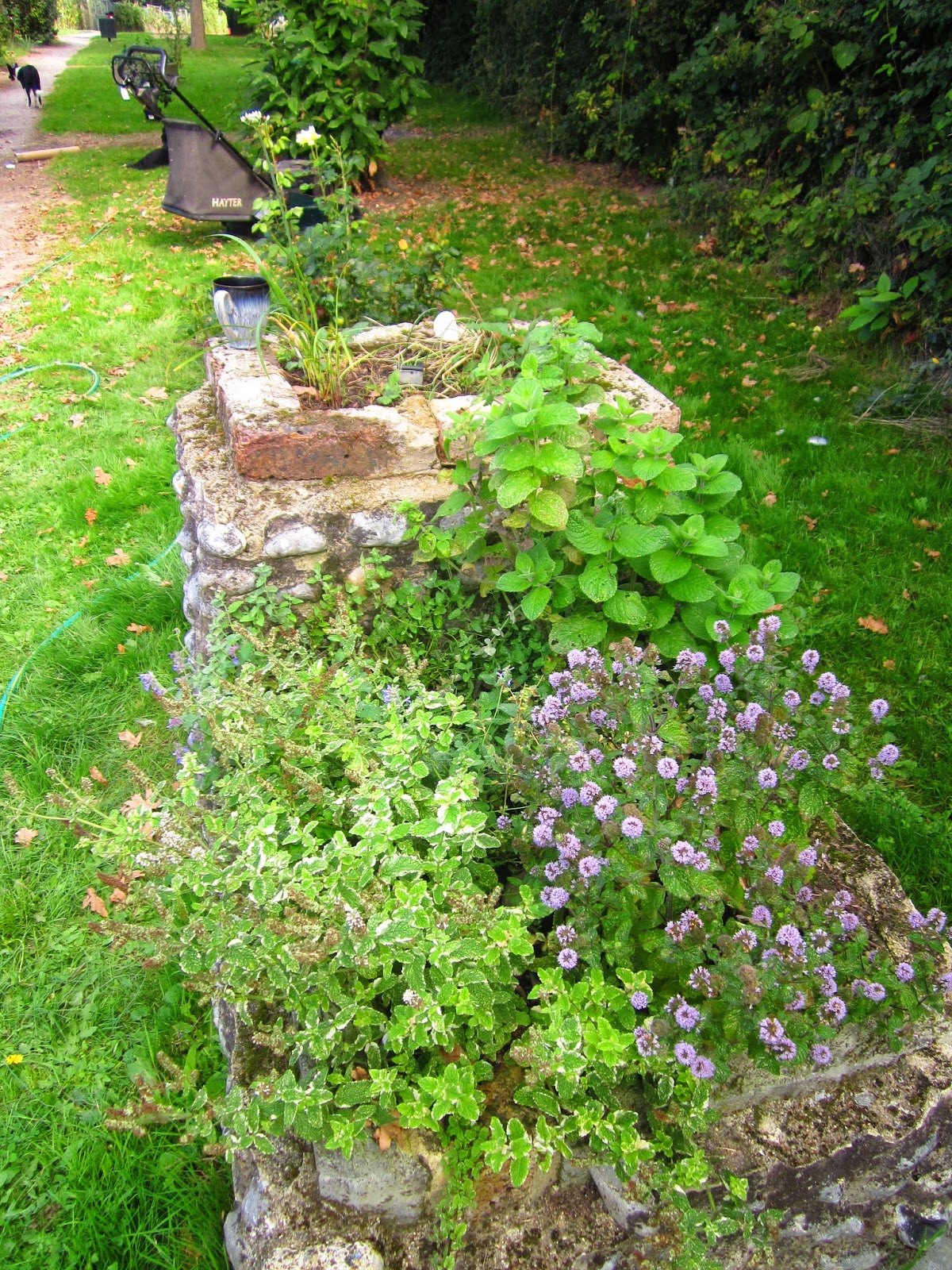
Some of us who backed onto the park then started to tidy it up. We then learned that there was money left for its upkeep by its previous owner and so we started to buy some plants. Last Saturday we had a big planting day when several new people came along to help. We also planted a memorial pear tree to a gentleman who liked the park and used to walk his dog there. this was kindly donated by some friends of his and his widow and daughter came along for the planting ceremony. Here are some photos that I took.





Some of us who backed onto the park then started to tidy it up. We then learned that there was money left for its upkeep by its previous owner and so we started to buy some plants. Last Saturday we had a big planting day when several new people came along to help. We also planted a memorial pear tree to a gentleman who liked the park and used to walk his dog there. this was kindly donated by some friends of his and his widow and daughter came along for the planting ceremony. Here are some photos that I took.
Sunday, 21 September 2014
The Wolf Pack Chapter 15
I apologise for not posting for a while, but I have been on holiday, then when I got back I have been rather busy. Anyway, here is the next installment of The Wolf Pack.
CHAPTER 15
JOB-HUNTING
When they re-entered the city, Fero was immediately struck by the smells. They had seemed considerably less in the parkland of the Duke, and he could almost imagine he was back in the countryside. However, when they left the gardens and park, the stink of the city hit him again.
‘How can people live like this?’ he thought.
When Carthinal and Asphodel left for their respective destinations, he and Basalt wandered around the city getting to know it a little better. It did not improve with the knowledge in his opinion.
‘The sooner I can get a job that takes me out of here the better,’ he grumbled to Basalt. ‘I really don’t like cities. They are crowded and they smell.’
‘Yes, well,’ replied the dwarf. ‘They do give a lot of employment to people though. There are many things that are good about them. The land could not support so many people all trying to grow food on their own small bits, or hunt the game in their own areas. It would soon be depleted, not to mention a little fact of safety. It’s safer in a city with others around and walls to protect you.’
‘I suppose you’re right, but that doesn’t mean I have to like it.’
They had found themselves once more outside the walls of the Ducal Palace in the centre of the city. It divided the city into four areas, and Basalt and Fero had just come from the area known as the Warren, which was the poor quarter of the city, and was the place where the thieves, assassins, common whores, beggars and honest poor lived out their lives. It was also the reason for Fero’s complaints about the smells, for although the city now boasted a sewer system, the homes in the Warren were not connected, as the inhabitants could not afford it. That and the close proximity of the dwellings and the unwashed bodies, not to mention the piles of horse dung. This latter was not cleaned up by the road cleaners, as they did not go into this area, it being deemed not important enough. All these things went to make the Warren a very smelly place to be. So the two of them decided to return to the Golden Dragon to get cleaned up and eat a meal.
After their meal, they were sitting in the main room of the inn when Carthinal returned from the Tower. He had a scruffy and smelly boy with curly red hair with him. Carthinal answered their queries by telling them that this was the boy who had stolen his pouch and he was going to question him about the theft and get his goods back.
The other two waited as Carthinal took the boy to their room to question him. Much to their amazement, Carthinal returned with the boy saying that he was going to get his stolen things back.
‘How do you think he got the boy to agree to return the goods?’ asked Fero.
‘Search me,’ replied the dwarf, ‘But mages can do some strange things and compel you against your will, it is said. Maybe he put some sort of glamour on the boy.’
‘Didn’t think he was powerful enough for that yet,’ replied Fero. ‘Still, if he can get that figurine, Duke Rollo would be grateful I think.’
Basalt took out his pipe and ordered a couple of ales for the pair of them. They sat there enjoying each other’s company, and planning what they were going to do the next day to find work.
Eventually, Carthinal returned. Fero sniffed the air and observed that Carthinal smelled like a sewer rat, but Bas was less restrained in his comments, and so Carthinal, grinning, left to partake of a bath. When he returned, he told them of his adventure in the sewers beneath the town, and that although he had got his pouch back, the boy had already sold the figurine. However, he was prepared to try to get it back.
‘You amaze me, Carthinal,’ said Fero. ‘How you managed to get a thief to return his ill-gotten gains I will never guess.’
‘No, friend, I don’t suppose you will,’ was all the reply he got. ‘I’ve got a test tomorrow, and so you will excuse me if I do some work for it, won’t you?’ and Carthinal began to open a book and read it.
Eventually, the others decided to leave him to it and go to bed.
The next morning, Fero and Basalt left the Inn to go in search of work. Fero decided to first go to the hiring hall where people looking for work could meet with potential employers. There were quite a lot of people putting themselves up for hire in various capacities, the largest being agricultural workers as it would soon be time for the spring planting. Fero stood in the area where the scouts and guides stood, it being close to the end of the time of year for hunting so there were few demands for hunters. There were not many others, and so he was fairly hopeful. There would still be a number of caravans travelling, and it would be increasing as the weather improved with the advent of spring. A man who was obviously a caravan leader soon approached him.
‘Are you prepared to travel over the Mountains of Doom to the Elven lands?’ he asked Fero. ‘There are some that don’t like crossing that range, I know, but you don’t look like someone of a nervous disposition.’
‘Not much frightens me,’ replied the ranger. ‘Do you want a scout? I’m afraid that I would be of little use to guide you as I’m not from these parts.’
‘A scout and a guard,’ replied the other. ‘That is if you are willing, and the price is right. What were you asking?’
Fero was just about to reply when a man came up to the caravan leader and tapped him on the shoulder, saying, ‘Excuse me, sir. May I have a word with you?’
‘I’ll be back in a minute to complete negotiations,’ said the caravan leader, and then he withdrew with the other man. They had an animated conversation for a few minutes and then the caravan leader walked away across the square and did not return.
‘I wonder what that was all about?’ wondered Fero.
He was not worried as there was still plenty of time to find employment. Lunchtime came and Fero bought a pie from a nearby stall and a mug of ale. He sat in the sunshine on a wall and ate it. He would be glad to get some employment if only to get out into the countryside. As the Vernal Equinox and New Year approached, he was becoming more and more restless at being in the city. He loved the spring, when the birds were beginning to sing their songs and young animals were being born. He especially loved the pale green of the new leaves on the trees, and the pleasant soft rain that fell to water the early flowers. He could hardly wait to get out.
After he had eaten, he went back to his stand, and was approached several times. Each time, it seemed that the man or woman changed their minds. Sometimes he saw someone speak to them, other times he did not.
‘This is most odd,’ he thought to himself. ‘I could almost imagine that there was someone who was trying to stop me from getting work. Why that should be I cannot imagine. I must be becoming paranoid.’
Whatever the case, he had not found employment by the eleventh hour, so he returned to the inn where he found Basalt just coming in. Bas it appeared had done no better than himself in the job-hunting. He told Fero what had happened.
After leaving Fero at the door of the inn, Basalt told him, he had decided to go straight to the barracks to try to get a job with the city guard. He did not really know where he was in respect of the barracks so he determined to ask someone. Of course, typically, the first person he spoke to was a stranger to the city and had no more idea than Basalt himself, but the next man was more helpful, and told him that the barracks was close to the Western Gate.
Basalt made his way through the streets until he came to Southgate Street, and turned north along it until he came to the gates of Duke Rollo’s palace. From there he skirted the grounds and came to Western Avenue leading to the Western Gate. Along the way he passed an inn and two taverns before he noticed a small side road leading to a large building with a high wall surrounding it. A gate, above which was a crest depicting a fish and a bale of silk; indicating that this was a town of fishing and trade, opened in the wall. Below the first crest was another that bore a sword crossed with a crossbow. Basalt took that to be the symbol of the Hambara guard. He approached the gates and pulled on the bell that was hanging there.
Shortly, a man approached the gates saying, ‘Yes! What is it you want?’
‘I am looking for work as a guard,’ explained Basalt.
‘Oh! Come on through then,’ the man replied, opening the gate, ‘The captain’ll see you in a few minutes. He’s busy at the moment. You can wait in the common room.’
The guard showed Basalt into the common room where there were a number of off duty guards sitting around. Some were sharpening weapons, others playing cards. Some were dozing in their chairs and yet others were exchanging meaningless banter, as is the way of guards and other military personnel. Basalt wandered over to a group that was playing a game of dice. He watched for a few moments as the game proceeded. He had never seen much point in games of dice, as it was pure chance as to how the dice fell with no skill at all involved. These dice were more complicated than the simple cubic dice of the mountain dwarves. Each of the dice had eight faces and so this made more combinations possible. This particular game seemed to involve three dice as well. He then wandered over to where there were some men playing cards. They were playing a game that was very popular on Vimar, called Rond. This involved skill as well as a little luck, and it was interesting to watch the tactics of the players as they tried to bluff and counter bluff each other and to guess each other’s cards without giving away their own hand. The players were all skilled and it seemed the game would go on for a long time. Judging by the pile of money in front of him, one player, a large blond man, had already won a great deal from his fellow players.
Basalt left the Rond game to sit near a bar in the corner. The barman struck up a conversation with him.
‘New recruit?’ he asked.
‘Hope so,’ replied Basalt. ‘I’m waiting to see the captain now. I believe he’s busy.’
The other snorted. ‘I doubt it, but he’ll pretend to be to make it seem he’s important. He’ll keep you waiting for a bit then call you in as though doing you a favour.’
‘I hope he will. Do me a favour that is. I’m getting a little short of cash and need a job.’
Just then, a young sergeant came into the room from a flight of stairs opposite the bar. He approached Basalt and told him to follow him up the stairs to see the captain. The stairs led to a small landing and the sergeant knocked on a door at the top.
‘Potential recruit to see you sir,’ he said.
A voice said, ‘Come in then.’ And the sergeant opened the door to admit Basalt.
The room was very organised with a large desk in the centre behind which sat a large man with greying hair and one of the largest moustaches that Basalt had ever seen.
‘Want to be in the Hambara guard do you?’ asked the captain. ‘Why?’
The question took Basalt by surprise. ‘I’ve got experience as a fighter and I need a job for financial reasons,’ he told the other man. ‘I don’t believe there are any wars at the moment so there are no army jobs going, so I thought of a town guard and here I am.’
‘I’d like to give you a job. You look a strong and determined man, but I’m afraid my hands are tied at the moment,’ the captain told him. ‘Duke Rollo has decreed that we are not to employ anyone not born in Hambara, or lived here for at least five years. He thinks that outsiders may not have the commitment to the town at best, and at worst be in league with smugglers and bandits. There it is. Left to me I’d give you a job right away. You look as though you’d be good, and we’re rather short staffed. If you come back in five years, having lived here all that time. I’ll be delighted to employ you.’
He stood up and offered Basalt his hand to shake, which the dwarf did, saying, ‘I doubt I’ll be here or anywhere else in five years unless I can find a job pretty soon. Where do the blacksmiths or metalworkers have their workshops? I’m pretty handy at shaping metal as well as wielding it.’
‘Yes,’ replied the captain, ‘I expect you are. After all you are a dwarf and you are all pretty good metal workers.’
After finding the way to the blacksmiths in the area, Basalt decided that he needed something to eat so he set off to the nearest tavern. There were two very close to the barracks, and he went into the nearest. Here he had a tankard of ale and a pie. The tavern was lively with guards and others who worked in the area, but Basalt was not anxious to tarry, as he wanted to get on with his job hunting.
The afternoon was spent going round the blacksmiths’ forges in the industrial area. The first one that he approached was friendly, but did not have any vacancies. He suggested another man whom he thought was possibly looking for help, so Basalt set off for the second blacksmith.
‘Hello,’ said the smith as Basalt entered his forge. ‘Can I help you?’
‘I hear you’re looking for someone to work here, and I’m looking for a job,’ replied Basalt. ‘I’ve done smith work before, and I’m strong and skilled.’
‘I’m sure you are, you being a dwarf and all,’ replied the smith. ‘However, I don’t have any work at present.’
‘I spoke to another smith and he directed me here saying that he thought that you were looking for help,’ Basalt told him.
‘Well, I was, but I found a boy this morning. Strong looking lad that I can train up. Pity you didn’t come sooner.’
‘Oh well. Thanks anyway,’ said a disappointed Basalt.
The afternoon passed in the same way and by the time the sun was setting, Basalt had still not found any work so he made his way back to the inn where he found an equally disappointed Fero waiting for him.
The two of them sat down to eat a meal and were sitting drinking when Carthinal came back. They asked him how he felt his tests had gone but he was rather brief in his answers as he said that he felt the need to go and do some work in preparation for the next day.
So Fero and Basalt decided to go and explore the taverns of Hambara. They had a lot to drink that evening, consuming quite a lot of dwarven spirits when they found an inn that could supply the “right” brand, as Basalt said. It appeared that there were many brands, which varied according to the area from which it came and the family that made it. All dwarves had their favourite and there was great rivalry between the different areas and families as to the best. Of course, all these different brands had to be sampled at various taverns and inns, and so they were in a rather happy state of mind when they arrived back at the Golden Dragon.
When they returned to the inn, they found that Carthinal was fast asleep. Even in their drunken state they knew that the next day was important for Carthinal and they tried to refrain from waking him. Fero tripped over his bed and Carthinal turned over and muttered something.
‘Sh!’ cautioned Bas, in a whisper that was louder than was needed. ‘You’ll wake the mage. Don’ want t’be turned into a frog d’you?’
Fero started laughing and nearly choked himself trying to laugh quietly. ‘Don’ think he can. ’S not good enough yet. Anyway, frogs’re OK. Jus’a bit slimy’s all.’ slurred Fero.
‘I know some folks’d be good frogs then,’ replied Bas, and then began to giggle.
He fell back onto his bed laughing at his own wit, and so the pair of them spent the next half hour laughing and shushing each other until they managed to undress after a fashion and fall into bed.
Fero woke late feeling rather ill. His head hurt and his stomach felt as though someone was stirring the contents with a spoon. He opened his eyes and immediately wished he had not as the daylight was much brighter than usual and made his head hurt more. He heard a groan from Basalt’s bed.
‘I’m dying,’ groaned the dwarf. ‘The dwarven spirits were poisoned.’
Fero realised, now that memory was returning, that the pair of them had drunk far too much the previous evening and were suffering from the mother of all hangovers.
‘No it wasn’t,’ he told the dwarf. ‘We just had too much. It’s a hangover not poisoned spirits that’s making you feel ill.’
‘Hangover?’ roared Bas, making Fero wince as his head pounded in time to Bas’s shout. ‘Insult me will you? I—NEVER—SUFFER—FROM—HANGOVERS. Bad drink will make me ill, but I never, ever get hangovers!’
With that, he collapsed back groaning, then reached for the water jug and was violently sick into it. ‘Poisoned we were,’ he muttered as much to himself as to Fero, who was not really listening as he was feeling as sorry for himself as Basalt was. ‘Poisoned. Not a hangover at all. We were poisoned!’
Eventually, the pair made their way gingerly down the stairs into the common room where they asked for a jug of water and two tankards, much to the delight and amusement of Mabrella. She could not help but tease them with offers of cooked breakfast and ale.
‘I’m never going to drink dwarven spirits again,’ declared Basalt with such vehemence that even Fero managed a smile.
‘Until the next time I suppose,’ he said to the dwarf, and got a glare for his trouble, but Basalt could not reply further as he had to rush out of the inn to be sick once again.
Eventually, they were both feeling a little better, but as it was nearly time for the lunchtime meal, they decided to eat before going out to resume their job hunting.
After eating and washing, and feeling almost human again, Fero returned once again to the hiring halls. The afternoon passed in much the same way as the previous day, and by the time the sun was setting he still had no employment. He decided then that he must get out of the city even if for only one night. He made his way across the large square to the inn. Here he went up the stairs to the room he was sharing with Carthinal and Basalt and collected his pack. On descending the stairs, he suddenly thought that his friends might be anxious if he just disappeared. He was not used to having others to think of as well as himself. He had been alone for a long time it seemed. He had not had enough formal education to be confident in writing, although he could sign his name, but he must leave them a message.
He left the inn and eventually, after crossing Doom Road, the main road out of the city to the east, he came to another main thoroughfare. It was known as Blue Lake Street as it led to the Water Street and the docks on the lake where the fishermen plied their trade. About half way along, he saw what he was looking for. A shop with a sign representing a quill pen. Here a clerk, or perhaps several worked and, for a small fee, would write letters or read them for clients. He entered and an elderly man looked up. He had a mop of snow-white hair, which looked rather unruly, as though he had been running his fingers through it. In fact, as Fero was preparing to speak, he did just that.
He squinted through his spectacles at Fero, and said, ‘I was just about to shut up shop as soon as I’ve finished this copy. I can’t work as well as I could in candlelight nowadays. What can I do for you young man? Is it a love letter? Most young men who come in here want love letters written.’
‘No,’ replied Fero. ‘I want to leave a note for some friends. How much do you charge?’
‘That depends on how long the note is. I charge by the word. Half a royal per word.’
‘That sounds all right,’ the ranger replied. ‘Will you write this down please?’
The man did so and Fero signed the letter and handed over the fee of 1 crown and 15 royals. He thanked the clerk and made his way back to the inn where he found Keloriff cleaning the bar. He gave the note to him and asked if he would be certain to give it to Carthinal or Basalt as soon as they returned, and with that he left the inn to head off for the open countryside.
He decided to go out at the Water Gate, as he rather liked the idea of sleeping with the sound of the lake lapping at its shores, so he quickly retraced his steps along Blue Lake Street to Water Street. When he came to the gate, he was surprised to see that the guards looked rather more alert than usual. To start with, there were two guards, one on each side of the gate, with halberds, and the sergeant was also in evidence.
As he approached, the two guards prevented his passage by lowering their weapons across the gate. The sergeant approached as he was about to remonstrate with the guards.
‘You! Come with me,’ said the sergeant. ‘We have reason to suppose that you have stolen goods on you.’
‘What is this?’ queried Fero. ‘There must be some mistake. I’ve got no stolen goods.’
‘Then you won’t mind us searching you, will you, mate?’ said the sergeant as he took Fero into the guardroom next to the gate.
‘Lads,’ he called to the two guards. ‘This is the one. One of you get the lieutenant, and the other one get in here and begin the search.’
‘Hey! What are you doing?’ Fero cried, as the guard, a rough looking man with a broken nose, grabbed the pack from his back. He was just about to reach for his sword when the other guard returned with a fourth man, obviously the lieutenant.
‘Well done, boys,’ said the lieutenant. ‘He certainly answers the description of the man we were told to look out for. Open his pack and let’s see what we’ve got.’
The first guard opened Fero’s pack and emptied it out onto the table. He rummaged through the things that had fallen out, then said, ‘Looks like we were wrong, sir. Nothing here.’
The lieutenant strode forward with his hands in his pockets, looking relaxed and confident. He hitched himself onto the table, leaving one leg on the floor, and looked with disdain at Fero’s worldly goods that were spread all over the table.
‘Now, maybe if I look. Maybe my eyesight is better than that of the guards. Perhaps I’ll find something.’
With that, he got off the table and, turning his back on Fero, began to move the contents of the pack around.
‘Aha! What is this? I knew it. Abain, you must see about some spectacles.’ This was to the guard who had searched the pack. ‘Here is the necklace that Duke Rollo said was missing. It belonged to his late wife you know. He is very attached to it.’ He held up a beautiful necklace for all to see. ‘Do you deny that you were at the Palace yesterday morning?’
‘N-no,’ stuttered Fero, unable to comprehend what was going on. That the lieutenant had planted the necklace was obvious, but why was more than Fero could work out. ‘We, that is my friends and I, went there on business and…’
‘Yes! Thieves business. Did you find out where any other valuables were? Are your friends going to return tonight to get more?’
Fero decided that arguing was not going to get him anywhere. He had to think this out. Maybe he was not mistaken in thinking that someone was trying to prevent him from getting work after all, although why was still a mystery to him. Then the two guards seized him roughly, removed his weapons from him and dragged him to the stairs in the corner of the room. They descended them and pushed Fero into a cell, locked the door and left him.
He looked round. The cell was small and damp, no more than three paces on either side. Along one wall was a shelf that Fero supposed was to serve as a bed since it had a thin blanket folded at one end and an equally thin pillow. Above the “bed” was a small barred window. Fero could see feet passing occasionally, so he knew he was on the town side of the wall. The door through which he had been thrust was opposite this window and had a small grill near the top. Fero peered through and saw a face peering through a similar grill opposite.
‘What you done?’ asked the face.
‘Nothing,’ replied Fero, unwilling to talk.
‘Then there’s nuffin’ you need worry about. The Duke’s a fair one an’ all. Me, I expect t’ be topped. Th’ man I ’it’s bought it they tells me. Still, I did do it so ’e’ll ’ave me done. I’ll not plead guilty, mind. Allus a chance.’
Fero looked puzzled.
‘“Bought it?”’ he asked. ‘What does that mean? And “Have you topped?”’
‘Oh! Yer bein’ a furriner ain’t yer!’ the man replied. ‘I mean that th’ man I ’it ’as died, and the Duke’ll send me ter th’ gallows fer it.’
‘You sound unconcerned about your death. Aren’t you afraid?’
‘Yeah! Course I am, but I’ll not let them guards know. Got some pride left, I ’ave,’ he continued. ‘Any road, I reckon that Kal'era’ll keep me there in th’ underworld for a while and then send me back on th’ Wheel ter do better. A new life can’t be worse’n this un.’
‘But suppose she thinks that you are unsaveable and destroys your soul?’ Fero continued. ‘By your own admission, you killed a man.’
‘Yeah, but t’was an accident. I’m not like one of yon assassins ’oo kills ’cos ’e enjoys it, and fer money too,’ replied the prisoner. ‘ ’E started th’ fight. I were only a thief. No evil in that is there? Any road, even Kal’era’ll giv’ a person a chance t’improve, like. Send me back on t’Wheel I ’spect.’
Fero turned away from the door and left the man. He did not feel like arguing about religion and morality or anything else at the moment. He went and sat down on the bench. How was he going to manage in this cell? His friends would not come to look for him, as they would think that he was staying out in the countryside, and justice was not quick in the towns he had heard.
He began to wonder what the punishment was for theft. He knew he was innocent, but who would take the word of a stranger against that of a lieutenant in the guard, although why the lieutenant would want to frame him he could not imagine. Whatever the punishment was, he knew that for him it would be dire. He could not stand imprisonment. That would be the worst punishment he could receive. If, however, the punishment were the removal of a hand or even fingers, this too would have severe implications, as it would mean that he would no longer be able to use his bow.
Fero felt the blackness. He tried to fight it, but could not use his usual methods of going out into the woods or doing something else to keep himself busy. Eventually, he turned over on his bench, faced the wall and gave in to despair.
Basalt had had a similarly disappointing time while enquiring amongst the metalworkers as he had had with the Guard and the smiths. As with the blacksmiths, they all seemed to want someone with less experience than the dwarf, or did not want to employ anyone at all. In a large town such as Hambara, Basalt found this state of affairs strange in the least. He wandered back to the inn, musing to himself.
When he arrived, Keloriff approached him with the note that Fero had left for him and Carthinal. He thanked the man, but did not open it, as it would have been a waste of time since he had never learned to read. It was not a skill that he had required in the mines as a youngster and he had not bothered to learn since. He would wait until Carthinal returned and he would ask him to read it. He did not have to wait too long before Carthinal came in through the door. He was in a buoyant mood, as he had now received the results of three tests and had passed all of them, the second with distinction, and the third with a merit. Basalt was pleased for him and after congratulating the mage, he handed him the note.
‘It’s from Fero,’ Basalt told him. ‘I think it’s telling us he’s gone out of town. He was rather restless and feeling the need for some fresh air, I think. Can’t blame the lad. I feel a bit like that myself.’
Carthinal opened the note and read,
‘Carthinal and Bas,
I have been unable to find work in the city, and I am becoming suffocated here. I cannot breathe this air or stand the press of so many people any longer. I am going out of the city and into the woods for tonight. I will return tomorrow to try my luck again in the Hiring Hall. I will come to the inn after that and eat with you at least.
Fero.’
Carthinal and Basalt ate their meal, fish from the lake, baked with a kind of sweet potato and tomatoes and onions. They finished the meal with goat’s cheese and bread and washed it down with ale.
‘I’m afraid I won’t be able to keep you company this evening, Bas,’ apologised Carthinal to the dwarf. Tomorrow’s test is to be the most important, the practical, and I must ensure that I have enough rest. I hope you don’t mind if I go to our room now.’
‘Of course not, laddie,’ replied the dwarf. ‘Your test is important. I’ll find someone to while away the time with.
’While Carthinal was resting, or trying to, thoughts of what might happen in the test kept passing through his mind. When he eventually fell asleep it was to dream of being bereft of his magic and pursued through impenetrable forests by horrific monsters.
Basalt was not troubled by any such thoughts. He was concentrating on a game of Rond, which he seemed to be winning.
By the end of the evening, he had a nice pile of crown pieces stacked up by his side. These he placed in his pouch and said, ‘Thank you gentlemen. Any time you’d like to play again, I’ll be pleased to join you.’
One of the three other card players grunted that he was too good for them, and maybe they should try a different game next time, and then bid him goodnight. Basalt climbed the stairs feeling a little more pleased as he now had some more money, but was still concerned as to finding a job.
The next morning, when Basalt woke, he was not looking forward to the day as he was still searching for a job. There was still a lot of options open. There were other metal workers that he had not yet approached, and he could also carve wood quite passably, so failing metalwork, he would try his hand at woodwork.
The morning passed in a similar vein to the previous day, but in the late afternoon, in a narrow back street, he came across a small metalworker’s shop. The goods in the window were of a high quality, and so he entered. A young man was there, working on an intricate piece.
‘I’ll be with you in a moment, sir,’ the young man said. ‘Just at a tricky bit. Take a look around while you wait.’
Basalt took the young man at his word and looked. The goods were of a high quality. Not quite as high as he himself could make, but if the young man was responsible, he was not very experienced yet and eventually, Basalt thought he would make a top craftsman.
‘There! That’s done,’ said the young man with feeling. ‘Now, what can I do for you? Sorry to have kept you waiting. Is it a commission, or do you want to buy something from stock?’
‘Neither,’ Bas replied. ‘I’m looking for work.’
‘Really?’ The young man looked surprised. ‘Are you any good? Do you have any examples of your work? Sorry to have to ask, but I’m new here in Hambara and have yet to make my reputation. If I take on a substandard worker, my reputation will suffer.’
‘Yes, I understand. Don’t fret yourself, my lad,’ replied the dwarf, fumbling in his backpack. ‘Now where is it? Ah! Here you are.’ He handed a piece of jewellery to the young man who took it to the window to inspect. ‘I don’t have any larger pieces on me, but I can do wrought iron work for whatever function you require.’ Basalt told him.
‘This is superb work,’ said a rather breathless young man. ‘Why has a craftsman like you come to me for work? Surely you could get a job with one of the more established shops in the town?’
‘No. It seems that no one is looking for a master craftsman at the moment, surprising as it may seem,’ replied the dwarf.
‘Well I am,’ said the young man, surprising Basalt as he was expecting the usual reply. ‘We’ll need to negotiate your pay, of course. I can’t afford the wages that are paid by most of the others in town, but I would really like to have you work for me. This work is the best I’ve seen. You’ll make my shop famous if your larger work is as good. Maybe eventually we can become partners.’ The young man's enthusiasm threatened to overwhelm him, then he said, ‘Are you sure you want to work here?’
Basalt replied in the affirmative and the two of them negotiated the rate of pay. It was considerably less than he was hoping for, but he knew the young man (whose name turned out to be Nitormon) was in no position to pay more, and so he made a token show of bargaining so as not to embarrass Nitormon. He also knew that in the future, Nitormon was going to make his name such was the quality of his work. They agreed for Basalt to begin work the following morning at the second hour.
That evening, Basalt returned to the inn in a much more cheerful frame of mind. He had a job, and he was looking forward to seeing Fero again, hoping he had also been successful, and also Carthinal as he was sure that he also would have something to celebrate.
He ate alone. Neither of his friends had come in. The evening was spoiled for him. He was worried. Fero had said that he would return to at least dine with them, and Carthinal should have been back from his practical test by now. Basalt hoped that the worst had not happened to Carthinal. Probably he had gone out to celebrate with the other candidates and would be back late, but his worry did not go away, and he fell into an uneasy sleep.
The next morning, when he woke and saw that Carthinal’s bed had not been slept in he was even more anxious. Perhaps he should go to the Tower and find out what had happened? Then he thought that he would look foolish and like an anxious mother if Carthinal was fine and had slept off his celebrations at the Tower. He could do nothing about Fero, but he imagined all sorts of things happening out in the wilds. So he set off for Nitormon’s shop. He entered, and was greeted by Nitormon warmly, and set to work on a complex piece of wrought ironware. It was to be a serving table for a rich house, one of those on the outskirts of the city. Nitormon worked alongside of him, and chatted about himself and asked few questions of Basalt, for which the dwarf was grateful. He did not feel in the mood for talking very much.
Lunchtime came, and he determined to go out of the shop and so he walked as far as the nearest tavern. His footsteps did begin to stray towards the Tower, but he made himself return. After lunch, he returned to the shop to find it closed. The door was locked and there was no sign of Nitormon.
He stood there puzzling out what had happened, when a passing woman said, ‘He’s gone. Don’t know where or why. I saw two men go in and a few minutes later, Nitormon came out with them, locked the shop and they all went off down the street. Nitormon looked uneasy, as though he didn’t want to go with them, but the men were big fellows so he probably had no choice. Hope he’s all right though. Nice chap, Nitormon. If you want to buy something, try Tendex in the main street. He’s almost as good. Goodbye.’
With that, she walked off leaving a puzzled Basalt standing looking at the shop. Bas could not think what Nitormon had done to be carted off like that. He could do nothing standing there though so he spent the rest of the afternoon worrying about his friends and his job and wandering the streets of Hambara until he decided to return to the Golden Dragon.
CHAPTER 15
JOB-HUNTING
When they re-entered the city, Fero was immediately struck by the smells. They had seemed considerably less in the parkland of the Duke, and he could almost imagine he was back in the countryside. However, when they left the gardens and park, the stink of the city hit him again.
‘How can people live like this?’ he thought.
When Carthinal and Asphodel left for their respective destinations, he and Basalt wandered around the city getting to know it a little better. It did not improve with the knowledge in his opinion.
‘The sooner I can get a job that takes me out of here the better,’ he grumbled to Basalt. ‘I really don’t like cities. They are crowded and they smell.’
‘Yes, well,’ replied the dwarf. ‘They do give a lot of employment to people though. There are many things that are good about them. The land could not support so many people all trying to grow food on their own small bits, or hunt the game in their own areas. It would soon be depleted, not to mention a little fact of safety. It’s safer in a city with others around and walls to protect you.’
‘I suppose you’re right, but that doesn’t mean I have to like it.’
They had found themselves once more outside the walls of the Ducal Palace in the centre of the city. It divided the city into four areas, and Basalt and Fero had just come from the area known as the Warren, which was the poor quarter of the city, and was the place where the thieves, assassins, common whores, beggars and honest poor lived out their lives. It was also the reason for Fero’s complaints about the smells, for although the city now boasted a sewer system, the homes in the Warren were not connected, as the inhabitants could not afford it. That and the close proximity of the dwellings and the unwashed bodies, not to mention the piles of horse dung. This latter was not cleaned up by the road cleaners, as they did not go into this area, it being deemed not important enough. All these things went to make the Warren a very smelly place to be. So the two of them decided to return to the Golden Dragon to get cleaned up and eat a meal.
After their meal, they were sitting in the main room of the inn when Carthinal returned from the Tower. He had a scruffy and smelly boy with curly red hair with him. Carthinal answered their queries by telling them that this was the boy who had stolen his pouch and he was going to question him about the theft and get his goods back.
The other two waited as Carthinal took the boy to their room to question him. Much to their amazement, Carthinal returned with the boy saying that he was going to get his stolen things back.
‘How do you think he got the boy to agree to return the goods?’ asked Fero.
‘Search me,’ replied the dwarf, ‘But mages can do some strange things and compel you against your will, it is said. Maybe he put some sort of glamour on the boy.’
‘Didn’t think he was powerful enough for that yet,’ replied Fero. ‘Still, if he can get that figurine, Duke Rollo would be grateful I think.’
Basalt took out his pipe and ordered a couple of ales for the pair of them. They sat there enjoying each other’s company, and planning what they were going to do the next day to find work.
Eventually, Carthinal returned. Fero sniffed the air and observed that Carthinal smelled like a sewer rat, but Bas was less restrained in his comments, and so Carthinal, grinning, left to partake of a bath. When he returned, he told them of his adventure in the sewers beneath the town, and that although he had got his pouch back, the boy had already sold the figurine. However, he was prepared to try to get it back.
‘You amaze me, Carthinal,’ said Fero. ‘How you managed to get a thief to return his ill-gotten gains I will never guess.’
‘No, friend, I don’t suppose you will,’ was all the reply he got. ‘I’ve got a test tomorrow, and so you will excuse me if I do some work for it, won’t you?’ and Carthinal began to open a book and read it.
Eventually, the others decided to leave him to it and go to bed.
The next morning, Fero and Basalt left the Inn to go in search of work. Fero decided to first go to the hiring hall where people looking for work could meet with potential employers. There were quite a lot of people putting themselves up for hire in various capacities, the largest being agricultural workers as it would soon be time for the spring planting. Fero stood in the area where the scouts and guides stood, it being close to the end of the time of year for hunting so there were few demands for hunters. There were not many others, and so he was fairly hopeful. There would still be a number of caravans travelling, and it would be increasing as the weather improved with the advent of spring. A man who was obviously a caravan leader soon approached him.
‘Are you prepared to travel over the Mountains of Doom to the Elven lands?’ he asked Fero. ‘There are some that don’t like crossing that range, I know, but you don’t look like someone of a nervous disposition.’
‘Not much frightens me,’ replied the ranger. ‘Do you want a scout? I’m afraid that I would be of little use to guide you as I’m not from these parts.’
‘A scout and a guard,’ replied the other. ‘That is if you are willing, and the price is right. What were you asking?’
Fero was just about to reply when a man came up to the caravan leader and tapped him on the shoulder, saying, ‘Excuse me, sir. May I have a word with you?’
‘I’ll be back in a minute to complete negotiations,’ said the caravan leader, and then he withdrew with the other man. They had an animated conversation for a few minutes and then the caravan leader walked away across the square and did not return.
‘I wonder what that was all about?’ wondered Fero.
He was not worried as there was still plenty of time to find employment. Lunchtime came and Fero bought a pie from a nearby stall and a mug of ale. He sat in the sunshine on a wall and ate it. He would be glad to get some employment if only to get out into the countryside. As the Vernal Equinox and New Year approached, he was becoming more and more restless at being in the city. He loved the spring, when the birds were beginning to sing their songs and young animals were being born. He especially loved the pale green of the new leaves on the trees, and the pleasant soft rain that fell to water the early flowers. He could hardly wait to get out.
After he had eaten, he went back to his stand, and was approached several times. Each time, it seemed that the man or woman changed their minds. Sometimes he saw someone speak to them, other times he did not.
‘This is most odd,’ he thought to himself. ‘I could almost imagine that there was someone who was trying to stop me from getting work. Why that should be I cannot imagine. I must be becoming paranoid.’
Whatever the case, he had not found employment by the eleventh hour, so he returned to the inn where he found Basalt just coming in. Bas it appeared had done no better than himself in the job-hunting. He told Fero what had happened.
After leaving Fero at the door of the inn, Basalt told him, he had decided to go straight to the barracks to try to get a job with the city guard. He did not really know where he was in respect of the barracks so he determined to ask someone. Of course, typically, the first person he spoke to was a stranger to the city and had no more idea than Basalt himself, but the next man was more helpful, and told him that the barracks was close to the Western Gate.
Basalt made his way through the streets until he came to Southgate Street, and turned north along it until he came to the gates of Duke Rollo’s palace. From there he skirted the grounds and came to Western Avenue leading to the Western Gate. Along the way he passed an inn and two taverns before he noticed a small side road leading to a large building with a high wall surrounding it. A gate, above which was a crest depicting a fish and a bale of silk; indicating that this was a town of fishing and trade, opened in the wall. Below the first crest was another that bore a sword crossed with a crossbow. Basalt took that to be the symbol of the Hambara guard. He approached the gates and pulled on the bell that was hanging there.
Shortly, a man approached the gates saying, ‘Yes! What is it you want?’
‘I am looking for work as a guard,’ explained Basalt.
‘Oh! Come on through then,’ the man replied, opening the gate, ‘The captain’ll see you in a few minutes. He’s busy at the moment. You can wait in the common room.’
The guard showed Basalt into the common room where there were a number of off duty guards sitting around. Some were sharpening weapons, others playing cards. Some were dozing in their chairs and yet others were exchanging meaningless banter, as is the way of guards and other military personnel. Basalt wandered over to a group that was playing a game of dice. He watched for a few moments as the game proceeded. He had never seen much point in games of dice, as it was pure chance as to how the dice fell with no skill at all involved. These dice were more complicated than the simple cubic dice of the mountain dwarves. Each of the dice had eight faces and so this made more combinations possible. This particular game seemed to involve three dice as well. He then wandered over to where there were some men playing cards. They were playing a game that was very popular on Vimar, called Rond. This involved skill as well as a little luck, and it was interesting to watch the tactics of the players as they tried to bluff and counter bluff each other and to guess each other’s cards without giving away their own hand. The players were all skilled and it seemed the game would go on for a long time. Judging by the pile of money in front of him, one player, a large blond man, had already won a great deal from his fellow players.
Basalt left the Rond game to sit near a bar in the corner. The barman struck up a conversation with him.
‘New recruit?’ he asked.
‘Hope so,’ replied Basalt. ‘I’m waiting to see the captain now. I believe he’s busy.’
The other snorted. ‘I doubt it, but he’ll pretend to be to make it seem he’s important. He’ll keep you waiting for a bit then call you in as though doing you a favour.’
‘I hope he will. Do me a favour that is. I’m getting a little short of cash and need a job.’
Just then, a young sergeant came into the room from a flight of stairs opposite the bar. He approached Basalt and told him to follow him up the stairs to see the captain. The stairs led to a small landing and the sergeant knocked on a door at the top.
‘Potential recruit to see you sir,’ he said.
A voice said, ‘Come in then.’ And the sergeant opened the door to admit Basalt.
The room was very organised with a large desk in the centre behind which sat a large man with greying hair and one of the largest moustaches that Basalt had ever seen.
‘Want to be in the Hambara guard do you?’ asked the captain. ‘Why?’
The question took Basalt by surprise. ‘I’ve got experience as a fighter and I need a job for financial reasons,’ he told the other man. ‘I don’t believe there are any wars at the moment so there are no army jobs going, so I thought of a town guard and here I am.’
‘I’d like to give you a job. You look a strong and determined man, but I’m afraid my hands are tied at the moment,’ the captain told him. ‘Duke Rollo has decreed that we are not to employ anyone not born in Hambara, or lived here for at least five years. He thinks that outsiders may not have the commitment to the town at best, and at worst be in league with smugglers and bandits. There it is. Left to me I’d give you a job right away. You look as though you’d be good, and we’re rather short staffed. If you come back in five years, having lived here all that time. I’ll be delighted to employ you.’
He stood up and offered Basalt his hand to shake, which the dwarf did, saying, ‘I doubt I’ll be here or anywhere else in five years unless I can find a job pretty soon. Where do the blacksmiths or metalworkers have their workshops? I’m pretty handy at shaping metal as well as wielding it.’
‘Yes,’ replied the captain, ‘I expect you are. After all you are a dwarf and you are all pretty good metal workers.’
After finding the way to the blacksmiths in the area, Basalt decided that he needed something to eat so he set off to the nearest tavern. There were two very close to the barracks, and he went into the nearest. Here he had a tankard of ale and a pie. The tavern was lively with guards and others who worked in the area, but Basalt was not anxious to tarry, as he wanted to get on with his job hunting.
The afternoon was spent going round the blacksmiths’ forges in the industrial area. The first one that he approached was friendly, but did not have any vacancies. He suggested another man whom he thought was possibly looking for help, so Basalt set off for the second blacksmith.
‘Hello,’ said the smith as Basalt entered his forge. ‘Can I help you?’
‘I hear you’re looking for someone to work here, and I’m looking for a job,’ replied Basalt. ‘I’ve done smith work before, and I’m strong and skilled.’
‘I’m sure you are, you being a dwarf and all,’ replied the smith. ‘However, I don’t have any work at present.’
‘I spoke to another smith and he directed me here saying that he thought that you were looking for help,’ Basalt told him.
‘Well, I was, but I found a boy this morning. Strong looking lad that I can train up. Pity you didn’t come sooner.’
‘Oh well. Thanks anyway,’ said a disappointed Basalt.
The afternoon passed in the same way and by the time the sun was setting, Basalt had still not found any work so he made his way back to the inn where he found an equally disappointed Fero waiting for him.
The two of them sat down to eat a meal and were sitting drinking when Carthinal came back. They asked him how he felt his tests had gone but he was rather brief in his answers as he said that he felt the need to go and do some work in preparation for the next day.
So Fero and Basalt decided to go and explore the taverns of Hambara. They had a lot to drink that evening, consuming quite a lot of dwarven spirits when they found an inn that could supply the “right” brand, as Basalt said. It appeared that there were many brands, which varied according to the area from which it came and the family that made it. All dwarves had their favourite and there was great rivalry between the different areas and families as to the best. Of course, all these different brands had to be sampled at various taverns and inns, and so they were in a rather happy state of mind when they arrived back at the Golden Dragon.
When they returned to the inn, they found that Carthinal was fast asleep. Even in their drunken state they knew that the next day was important for Carthinal and they tried to refrain from waking him. Fero tripped over his bed and Carthinal turned over and muttered something.
‘Sh!’ cautioned Bas, in a whisper that was louder than was needed. ‘You’ll wake the mage. Don’ want t’be turned into a frog d’you?’
Fero started laughing and nearly choked himself trying to laugh quietly. ‘Don’ think he can. ’S not good enough yet. Anyway, frogs’re OK. Jus’a bit slimy’s all.’ slurred Fero.
‘I know some folks’d be good frogs then,’ replied Bas, and then began to giggle.
He fell back onto his bed laughing at his own wit, and so the pair of them spent the next half hour laughing and shushing each other until they managed to undress after a fashion and fall into bed.
Fero woke late feeling rather ill. His head hurt and his stomach felt as though someone was stirring the contents with a spoon. He opened his eyes and immediately wished he had not as the daylight was much brighter than usual and made his head hurt more. He heard a groan from Basalt’s bed.
‘I’m dying,’ groaned the dwarf. ‘The dwarven spirits were poisoned.’
Fero realised, now that memory was returning, that the pair of them had drunk far too much the previous evening and were suffering from the mother of all hangovers.
‘No it wasn’t,’ he told the dwarf. ‘We just had too much. It’s a hangover not poisoned spirits that’s making you feel ill.’
‘Hangover?’ roared Bas, making Fero wince as his head pounded in time to Bas’s shout. ‘Insult me will you? I—NEVER—SUFFER—FROM—HANGOVERS. Bad drink will make me ill, but I never, ever get hangovers!’
With that, he collapsed back groaning, then reached for the water jug and was violently sick into it. ‘Poisoned we were,’ he muttered as much to himself as to Fero, who was not really listening as he was feeling as sorry for himself as Basalt was. ‘Poisoned. Not a hangover at all. We were poisoned!’
Eventually, the pair made their way gingerly down the stairs into the common room where they asked for a jug of water and two tankards, much to the delight and amusement of Mabrella. She could not help but tease them with offers of cooked breakfast and ale.
‘I’m never going to drink dwarven spirits again,’ declared Basalt with such vehemence that even Fero managed a smile.
‘Until the next time I suppose,’ he said to the dwarf, and got a glare for his trouble, but Basalt could not reply further as he had to rush out of the inn to be sick once again.
Eventually, they were both feeling a little better, but as it was nearly time for the lunchtime meal, they decided to eat before going out to resume their job hunting.
After eating and washing, and feeling almost human again, Fero returned once again to the hiring halls. The afternoon passed in much the same way as the previous day, and by the time the sun was setting he still had no employment. He decided then that he must get out of the city even if for only one night. He made his way across the large square to the inn. Here he went up the stairs to the room he was sharing with Carthinal and Basalt and collected his pack. On descending the stairs, he suddenly thought that his friends might be anxious if he just disappeared. He was not used to having others to think of as well as himself. He had been alone for a long time it seemed. He had not had enough formal education to be confident in writing, although he could sign his name, but he must leave them a message.
He left the inn and eventually, after crossing Doom Road, the main road out of the city to the east, he came to another main thoroughfare. It was known as Blue Lake Street as it led to the Water Street and the docks on the lake where the fishermen plied their trade. About half way along, he saw what he was looking for. A shop with a sign representing a quill pen. Here a clerk, or perhaps several worked and, for a small fee, would write letters or read them for clients. He entered and an elderly man looked up. He had a mop of snow-white hair, which looked rather unruly, as though he had been running his fingers through it. In fact, as Fero was preparing to speak, he did just that.
He squinted through his spectacles at Fero, and said, ‘I was just about to shut up shop as soon as I’ve finished this copy. I can’t work as well as I could in candlelight nowadays. What can I do for you young man? Is it a love letter? Most young men who come in here want love letters written.’
‘No,’ replied Fero. ‘I want to leave a note for some friends. How much do you charge?’
‘That depends on how long the note is. I charge by the word. Half a royal per word.’
‘That sounds all right,’ the ranger replied. ‘Will you write this down please?’
The man did so and Fero signed the letter and handed over the fee of 1 crown and 15 royals. He thanked the clerk and made his way back to the inn where he found Keloriff cleaning the bar. He gave the note to him and asked if he would be certain to give it to Carthinal or Basalt as soon as they returned, and with that he left the inn to head off for the open countryside.
He decided to go out at the Water Gate, as he rather liked the idea of sleeping with the sound of the lake lapping at its shores, so he quickly retraced his steps along Blue Lake Street to Water Street. When he came to the gate, he was surprised to see that the guards looked rather more alert than usual. To start with, there were two guards, one on each side of the gate, with halberds, and the sergeant was also in evidence.
As he approached, the two guards prevented his passage by lowering their weapons across the gate. The sergeant approached as he was about to remonstrate with the guards.
‘You! Come with me,’ said the sergeant. ‘We have reason to suppose that you have stolen goods on you.’
‘What is this?’ queried Fero. ‘There must be some mistake. I’ve got no stolen goods.’
‘Then you won’t mind us searching you, will you, mate?’ said the sergeant as he took Fero into the guardroom next to the gate.
‘Lads,’ he called to the two guards. ‘This is the one. One of you get the lieutenant, and the other one get in here and begin the search.’
‘Hey! What are you doing?’ Fero cried, as the guard, a rough looking man with a broken nose, grabbed the pack from his back. He was just about to reach for his sword when the other guard returned with a fourth man, obviously the lieutenant.
‘Well done, boys,’ said the lieutenant. ‘He certainly answers the description of the man we were told to look out for. Open his pack and let’s see what we’ve got.’
The first guard opened Fero’s pack and emptied it out onto the table. He rummaged through the things that had fallen out, then said, ‘Looks like we were wrong, sir. Nothing here.’
The lieutenant strode forward with his hands in his pockets, looking relaxed and confident. He hitched himself onto the table, leaving one leg on the floor, and looked with disdain at Fero’s worldly goods that were spread all over the table.
‘Now, maybe if I look. Maybe my eyesight is better than that of the guards. Perhaps I’ll find something.’
With that, he got off the table and, turning his back on Fero, began to move the contents of the pack around.
‘Aha! What is this? I knew it. Abain, you must see about some spectacles.’ This was to the guard who had searched the pack. ‘Here is the necklace that Duke Rollo said was missing. It belonged to his late wife you know. He is very attached to it.’ He held up a beautiful necklace for all to see. ‘Do you deny that you were at the Palace yesterday morning?’
‘N-no,’ stuttered Fero, unable to comprehend what was going on. That the lieutenant had planted the necklace was obvious, but why was more than Fero could work out. ‘We, that is my friends and I, went there on business and…’
‘Yes! Thieves business. Did you find out where any other valuables were? Are your friends going to return tonight to get more?’
Fero decided that arguing was not going to get him anywhere. He had to think this out. Maybe he was not mistaken in thinking that someone was trying to prevent him from getting work after all, although why was still a mystery to him. Then the two guards seized him roughly, removed his weapons from him and dragged him to the stairs in the corner of the room. They descended them and pushed Fero into a cell, locked the door and left him.
He looked round. The cell was small and damp, no more than three paces on either side. Along one wall was a shelf that Fero supposed was to serve as a bed since it had a thin blanket folded at one end and an equally thin pillow. Above the “bed” was a small barred window. Fero could see feet passing occasionally, so he knew he was on the town side of the wall. The door through which he had been thrust was opposite this window and had a small grill near the top. Fero peered through and saw a face peering through a similar grill opposite.
‘What you done?’ asked the face.
‘Nothing,’ replied Fero, unwilling to talk.
‘Then there’s nuffin’ you need worry about. The Duke’s a fair one an’ all. Me, I expect t’ be topped. Th’ man I ’it’s bought it they tells me. Still, I did do it so ’e’ll ’ave me done. I’ll not plead guilty, mind. Allus a chance.’
Fero looked puzzled.
‘“Bought it?”’ he asked. ‘What does that mean? And “Have you topped?”’
‘Oh! Yer bein’ a furriner ain’t yer!’ the man replied. ‘I mean that th’ man I ’it ’as died, and the Duke’ll send me ter th’ gallows fer it.’
‘You sound unconcerned about your death. Aren’t you afraid?’
‘Yeah! Course I am, but I’ll not let them guards know. Got some pride left, I ’ave,’ he continued. ‘Any road, I reckon that Kal'era’ll keep me there in th’ underworld for a while and then send me back on th’ Wheel ter do better. A new life can’t be worse’n this un.’
‘But suppose she thinks that you are unsaveable and destroys your soul?’ Fero continued. ‘By your own admission, you killed a man.’
‘Yeah, but t’was an accident. I’m not like one of yon assassins ’oo kills ’cos ’e enjoys it, and fer money too,’ replied the prisoner. ‘ ’E started th’ fight. I were only a thief. No evil in that is there? Any road, even Kal’era’ll giv’ a person a chance t’improve, like. Send me back on t’Wheel I ’spect.’
Fero turned away from the door and left the man. He did not feel like arguing about religion and morality or anything else at the moment. He went and sat down on the bench. How was he going to manage in this cell? His friends would not come to look for him, as they would think that he was staying out in the countryside, and justice was not quick in the towns he had heard.
He began to wonder what the punishment was for theft. He knew he was innocent, but who would take the word of a stranger against that of a lieutenant in the guard, although why the lieutenant would want to frame him he could not imagine. Whatever the punishment was, he knew that for him it would be dire. He could not stand imprisonment. That would be the worst punishment he could receive. If, however, the punishment were the removal of a hand or even fingers, this too would have severe implications, as it would mean that he would no longer be able to use his bow.
Fero felt the blackness. He tried to fight it, but could not use his usual methods of going out into the woods or doing something else to keep himself busy. Eventually, he turned over on his bench, faced the wall and gave in to despair.
Basalt had had a similarly disappointing time while enquiring amongst the metalworkers as he had had with the Guard and the smiths. As with the blacksmiths, they all seemed to want someone with less experience than the dwarf, or did not want to employ anyone at all. In a large town such as Hambara, Basalt found this state of affairs strange in the least. He wandered back to the inn, musing to himself.
When he arrived, Keloriff approached him with the note that Fero had left for him and Carthinal. He thanked the man, but did not open it, as it would have been a waste of time since he had never learned to read. It was not a skill that he had required in the mines as a youngster and he had not bothered to learn since. He would wait until Carthinal returned and he would ask him to read it. He did not have to wait too long before Carthinal came in through the door. He was in a buoyant mood, as he had now received the results of three tests and had passed all of them, the second with distinction, and the third with a merit. Basalt was pleased for him and after congratulating the mage, he handed him the note.
‘It’s from Fero,’ Basalt told him. ‘I think it’s telling us he’s gone out of town. He was rather restless and feeling the need for some fresh air, I think. Can’t blame the lad. I feel a bit like that myself.’
Carthinal opened the note and read,
‘Carthinal and Bas,
I have been unable to find work in the city, and I am becoming suffocated here. I cannot breathe this air or stand the press of so many people any longer. I am going out of the city and into the woods for tonight. I will return tomorrow to try my luck again in the Hiring Hall. I will come to the inn after that and eat with you at least.
Fero.’
Carthinal and Basalt ate their meal, fish from the lake, baked with a kind of sweet potato and tomatoes and onions. They finished the meal with goat’s cheese and bread and washed it down with ale.
‘I’m afraid I won’t be able to keep you company this evening, Bas,’ apologised Carthinal to the dwarf. Tomorrow’s test is to be the most important, the practical, and I must ensure that I have enough rest. I hope you don’t mind if I go to our room now.’
‘Of course not, laddie,’ replied the dwarf. ‘Your test is important. I’ll find someone to while away the time with.
’While Carthinal was resting, or trying to, thoughts of what might happen in the test kept passing through his mind. When he eventually fell asleep it was to dream of being bereft of his magic and pursued through impenetrable forests by horrific monsters.
Basalt was not troubled by any such thoughts. He was concentrating on a game of Rond, which he seemed to be winning.
By the end of the evening, he had a nice pile of crown pieces stacked up by his side. These he placed in his pouch and said, ‘Thank you gentlemen. Any time you’d like to play again, I’ll be pleased to join you.’
One of the three other card players grunted that he was too good for them, and maybe they should try a different game next time, and then bid him goodnight. Basalt climbed the stairs feeling a little more pleased as he now had some more money, but was still concerned as to finding a job.
The next morning, when Basalt woke, he was not looking forward to the day as he was still searching for a job. There was still a lot of options open. There were other metal workers that he had not yet approached, and he could also carve wood quite passably, so failing metalwork, he would try his hand at woodwork.
The morning passed in a similar vein to the previous day, but in the late afternoon, in a narrow back street, he came across a small metalworker’s shop. The goods in the window were of a high quality, and so he entered. A young man was there, working on an intricate piece.
‘I’ll be with you in a moment, sir,’ the young man said. ‘Just at a tricky bit. Take a look around while you wait.’
Basalt took the young man at his word and looked. The goods were of a high quality. Not quite as high as he himself could make, but if the young man was responsible, he was not very experienced yet and eventually, Basalt thought he would make a top craftsman.
‘There! That’s done,’ said the young man with feeling. ‘Now, what can I do for you? Sorry to have kept you waiting. Is it a commission, or do you want to buy something from stock?’
‘Neither,’ Bas replied. ‘I’m looking for work.’
‘Really?’ The young man looked surprised. ‘Are you any good? Do you have any examples of your work? Sorry to have to ask, but I’m new here in Hambara and have yet to make my reputation. If I take on a substandard worker, my reputation will suffer.’
‘Yes, I understand. Don’t fret yourself, my lad,’ replied the dwarf, fumbling in his backpack. ‘Now where is it? Ah! Here you are.’ He handed a piece of jewellery to the young man who took it to the window to inspect. ‘I don’t have any larger pieces on me, but I can do wrought iron work for whatever function you require.’ Basalt told him.
‘This is superb work,’ said a rather breathless young man. ‘Why has a craftsman like you come to me for work? Surely you could get a job with one of the more established shops in the town?’
‘No. It seems that no one is looking for a master craftsman at the moment, surprising as it may seem,’ replied the dwarf.
‘Well I am,’ said the young man, surprising Basalt as he was expecting the usual reply. ‘We’ll need to negotiate your pay, of course. I can’t afford the wages that are paid by most of the others in town, but I would really like to have you work for me. This work is the best I’ve seen. You’ll make my shop famous if your larger work is as good. Maybe eventually we can become partners.’ The young man's enthusiasm threatened to overwhelm him, then he said, ‘Are you sure you want to work here?’
Basalt replied in the affirmative and the two of them negotiated the rate of pay. It was considerably less than he was hoping for, but he knew the young man (whose name turned out to be Nitormon) was in no position to pay more, and so he made a token show of bargaining so as not to embarrass Nitormon. He also knew that in the future, Nitormon was going to make his name such was the quality of his work. They agreed for Basalt to begin work the following morning at the second hour.
That evening, Basalt returned to the inn in a much more cheerful frame of mind. He had a job, and he was looking forward to seeing Fero again, hoping he had also been successful, and also Carthinal as he was sure that he also would have something to celebrate.
He ate alone. Neither of his friends had come in. The evening was spoiled for him. He was worried. Fero had said that he would return to at least dine with them, and Carthinal should have been back from his practical test by now. Basalt hoped that the worst had not happened to Carthinal. Probably he had gone out to celebrate with the other candidates and would be back late, but his worry did not go away, and he fell into an uneasy sleep.
The next morning, when he woke and saw that Carthinal’s bed had not been slept in he was even more anxious. Perhaps he should go to the Tower and find out what had happened? Then he thought that he would look foolish and like an anxious mother if Carthinal was fine and had slept off his celebrations at the Tower. He could do nothing about Fero, but he imagined all sorts of things happening out in the wilds. So he set off for Nitormon’s shop. He entered, and was greeted by Nitormon warmly, and set to work on a complex piece of wrought ironware. It was to be a serving table for a rich house, one of those on the outskirts of the city. Nitormon worked alongside of him, and chatted about himself and asked few questions of Basalt, for which the dwarf was grateful. He did not feel in the mood for talking very much.
Lunchtime came, and he determined to go out of the shop and so he walked as far as the nearest tavern. His footsteps did begin to stray towards the Tower, but he made himself return. After lunch, he returned to the shop to find it closed. The door was locked and there was no sign of Nitormon.
He stood there puzzling out what had happened, when a passing woman said, ‘He’s gone. Don’t know where or why. I saw two men go in and a few minutes later, Nitormon came out with them, locked the shop and they all went off down the street. Nitormon looked uneasy, as though he didn’t want to go with them, but the men were big fellows so he probably had no choice. Hope he’s all right though. Nice chap, Nitormon. If you want to buy something, try Tendex in the main street. He’s almost as good. Goodbye.’
With that, she walked off leaving a puzzled Basalt standing looking at the shop. Bas could not think what Nitormon had done to be carted off like that. He could do nothing standing there though so he spent the rest of the afternoon worrying about his friends and his job and wandering the streets of Hambara until he decided to return to the Golden Dragon.
Tuesday, 2 September 2014
Hello everybody.
I'm off on holiday tomorrow. I may be able to post a few comments if the local WiFi permits, but if I am off for a couple of weeks, that's where I am.
Thought! When I learned to drive, many long years ago, I learned that when entering a roundabout it was not necessary to give a signal until the exit before the one that I was taking. This was because there is only one way to go round a roundabout! Then came mini-roundabouts and somehow they were treated as normal cross roads and people began to give a right turn if they were taking the right hand exit.
In my opinion this has led to great confusion in signalling. Many people signal right turn when they are going to take the straight on option, thus causing confusion. There is a problem with roundabouts that don't have the standard four exits too. What do you do with five or six exits. If you signal right turn for the fourth, how does anyone know you aren't taking the fifth? Another problem is for people entering the roundabout. It is not always possible to see where a vehicle has entered and so they may be taking the exit before yours, or not. What signal do you give if you are going right round and back the way you came?
Mini roundabouts are a menace too. People often completely ignore the fact that they are roundabouts. Many folk drive right over them, and one near to where I live, people actually go the wrong way round it! It has four exits, but two of them are very close together and so if people are taking the right-hand one, they simply drive down it as though the roundabout weren't there! I don't suppose they think of it as going the wrong way round, but they are.
This signalling is now actually taught to drivers, but in my opinion it causes more confusion than it clears up.
Thought! When I learned to drive, many long years ago, I learned that when entering a roundabout it was not necessary to give a signal until the exit before the one that I was taking. This was because there is only one way to go round a roundabout! Then came mini-roundabouts and somehow they were treated as normal cross roads and people began to give a right turn if they were taking the right hand exit.
In my opinion this has led to great confusion in signalling. Many people signal right turn when they are going to take the straight on option, thus causing confusion. There is a problem with roundabouts that don't have the standard four exits too. What do you do with five or six exits. If you signal right turn for the fourth, how does anyone know you aren't taking the fifth? Another problem is for people entering the roundabout. It is not always possible to see where a vehicle has entered and so they may be taking the exit before yours, or not. What signal do you give if you are going right round and back the way you came?
Mini roundabouts are a menace too. People often completely ignore the fact that they are roundabouts. Many folk drive right over them, and one near to where I live, people actually go the wrong way round it! It has four exits, but two of them are very close together and so if people are taking the right-hand one, they simply drive down it as though the roundabout weren't there! I don't suppose they think of it as going the wrong way round, but they are.
This signalling is now actually taught to drivers, but in my opinion it causes more confusion than it clears up.
Subscribe to:
Posts (Atom)